
Back to Resources | Jump to Contents
Emotional Intelligence (EI or EQ) is such a powerful force, and like any form of power it can be used for good or evil. I believe EQ is a requirement for great leadership. The father of emotional intelligence, Daniel Goleman, argues “the primal job of leadership is emotional.”
Contents
- Primal Leadership: Unleashing the Power of Emotional Intelligence, by Daniel Goleman, Richard E. Boyatzis, and Annie McKee.
- Permission to Feel: Unlocking the Power of Emotions to Help Our Kids, Ourselves, and Our Society Thrive, by Marc Brackett, founding director of the Yale Center for Emotional Intelligence.
- Atlas of the Heart: Mapping Meaningful Connection and the Language of Human Experience, by Brené Brown.
- Emotional Agility: Get Unstuck, Embrace Change, and Thrive in Work and Life, by Susan David.
- Documentary: Master Class in EQ from the Horse Whisperer, Buck Brannaman
- Social Media EQ faves
Primal Leadership: Unleashing the Power of Emotional Intelligence, by Daniel Goleman, Richard E. Boyatzis, and Annie McKee.

Daniel Goleman’s name is associated with emotional intelligence even more than the researchers who coined the phrase! He popularized the concept in his book Emotional Intelligence: Why It Can Matter More Than IQ. This first book organizes EQ into 4 domains:
| Emotional Intelligence Components | Description |
|---|---|
| Emotional Self-Awareness | Understanding your own emotions and their effects on your thoughts and behavior. |
| Emotional Regulation | Managing your emotional responses in various situations to maintain control. |
| Social Awareness | Recognizing and understanding the emotions of others and the dynamics of social situations. |
| Relationship Management | Building and maintaining healthy relationships through effective communication and conflict resolution. |
Primal Leadership could be called EQ for Leaders. In it, the authors argue that “The fundamental task of leaders is to prime good feeling in those they lead. That occurs when a leader creates resonance, a reservoir of positivity that frees the best in people. At its root, then, the primal job of leadership is emotional.” They map leadership onto those 4 domains of EQ that I listed above.
This is one of those books where I stopped regularly to make notes! Here are some of my fave takeaways:
“We believe this primal dimension of leadership, though often invisible or ignored entirely, determines whether everything else a leader does will work as well as it could. And this is why emotional intelligence, being intelligent about emotions, matters so much for leadership success.”
“Primal leadership demands we bring emotional intelligence to bear.”
“Increases in anxiety and worry erode mental abilities. Distress not only erodes mental abilities, it also makes people less emotionally intelligent. People who are upset have trouble reading emotions accurately in other people, decreasing the most basic skill needed for empathy and, as a result impairing their social skills.”
For every 1% improvement in emotional climate, there is a 2% increase in sales (aka performance)
EI leaders create resonance – harmony, in sync, on the same wavelength (as opposed to dissonance, discord, off key)
Dissonant leaders are those who create an unpleasant, uncomfortable experience for staff when they fail to recognize that their own emotional state impacts the team the same way dissonant chords impact the audience. (In other words, toxic leadership.)
“Tuned out, dissonant leaders are one of the main reasons that talented people leave and take the organizations knowledge with them.”
- Primal Leadership has 3 parts:
- The first explains all about emotional intelligence, including some neuroscience to help us understand where emotions happen and why they are contagious.
- Part 2 is about developing emotional intelligence in leaders at the individual level – how to work on EI skills.
- Part 3 is about emotionally intelligent organizations – making it part of your culture.
Bonus:
- Harvard Business Review article on Primal Leadership, and a book summary with graphics.
*The only part I found distracting about this book is that the pronouns aren’t very inclusive. Leaders are mostly only referred to as “he”.
Permission to Feel: Unlocking the Power of Emotions to Help Our Kids, Ourselves, and Our Society Thrive, by Marc Brackett, founding director of the Yale Center for Emotional Intelligence.
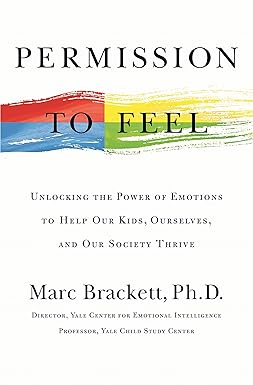
Emotional literacy — being able to recognize, name, and understand our feelings — affects everything from learning, decision-making, and creativity to relationships, health, and performance.
Even though Marc Brackett is a professor in Yale University’s Child Study Center, and all this works on kids and has been implemented in schools…it’s also perfectly applicable to adults. After all, there’s a little child inside all of us! And when we’re experiencing strong emotions, we might have a hard time not being a little childish.
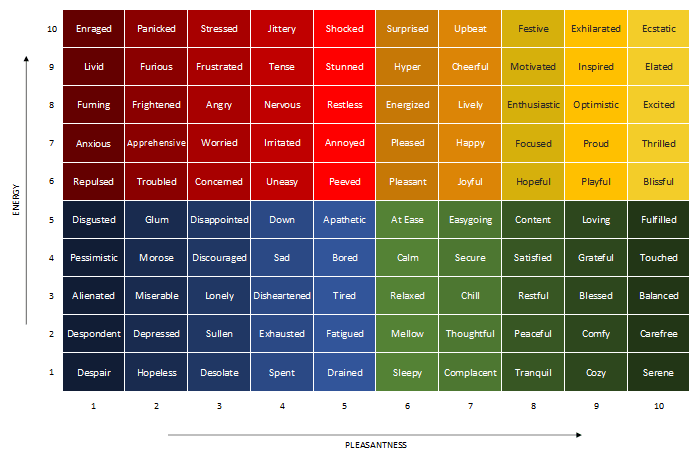
Two big takeaways from this book that I find myself talking about a lot are the RULER model and the emotions chart. The RULER model outlines the “self” half of Goleman’s four emotional intelligence domains (emotional self-awareness and emotional regulation). Self-awareness is about Recognizing and Understanding the emotion, and Labelling it. Emotional regulation maps onto Expressing the emotion and Regulating it.
When I’m facilitating learning on emotional intelligence and show people the emotions chart, it immediately resonates. Most people off the top of their head can only list about 3-5 emotions (happy, sad, angry, maybe frustrated or calm). Having this chart really helps, like when you’re in the mall and you look on the map for the “you are here” sign. Putting a word on how you’re feeling really helps! Once it’s labeled, it can be processed.
Bonus: Marc Brackett discusses Permission to Feel with Brené Brown.
Atlas of the Heart: Mapping Meaningful Connection and the Language of Human Experience, by Brené Brown.
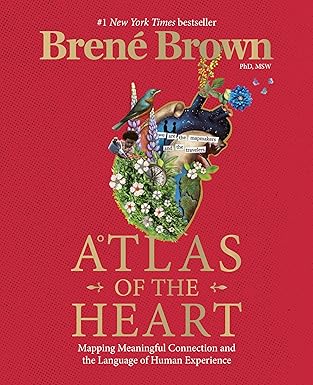
This book really is an atlas! And it’s beautiful.
It’s organized by categories of emotions, like “Places we go with others” (empathy, compassion, pity) or “Places we go when things are uncertain or too much” (anxiety, worry, avoidance, dread, fear). I learned about the difference between guilt and shame; the difference between envy and jealousy. I learned that resentment, which I thought was a form of righteous anger, is actually a form of envy.
Brené Brown is a storyteller, and that means she’s serious about people sharing their stories, truly hearing and understand other people’s stories, and being good stewards of our/others’ stories. After all, stories are how humans make meaning. I think of the opposite of story stewardship as being gaslighting and the like.
Once we learn about emotions, we can connect with them inside of ourselves. Then we can connect with other people’s emotions. No minimizing, avoiding, gaslighting, invalidating. And we can hold space for other people’s experience without losing sight of our own. Brown shares, “I want this book to be an atlas for all of us, because I believe that, with an adventurous heart and the right maps, we can travel anywhere and never fear losing ourselves.”
Bonus materials relating to Atlas of the Heart:
- Article on Story Stewardship, adapted from the book
- Atlas Hub – read-along resources, art from the book, and podcasts episodes related to the book
- Podcast episodes with Brené and her sisters, where they hilariously and vulnerably discuss how the book came about, as well as a chapter of the book written by the author.
- Five Part Series on HBO Max that goes through all of Atlas of the Heart. In Canada, look for it on Bell Media (streaming on Crave)
Emotional Agility: Get Unstuck, Embrace Change, and Thrive in Work and Life, by Susan David.

Dr. David found that no matter how intelligent or creative people are, or what type of personality they have, it is how they navigate their inner world—their thoughts, feelings, and self-talk—that ultimately determines how successful they will become.
This is a great description from the Amazon writeup: “The way we respond to these internal experiences drives our actions, careers, relationships, happiness, health—everything that matters in our lives. As humans, we are all prone to common hooks—things like self-doubt, shame, sadness, fear, or anger—that can too easily steer us in the wrong direction. Emotionally agile people are not immune to stresses and setbacks. The key difference is that they know how to adapt, aligning their actions with their values and making small but powerful changes that lead to a lifetime of growth. Emotional agility is not about ignoring difficult emotions and thoughts; it’s about holding them loosely, facing them courageously and compassionately, and then moving past them to bring the best of yourself forward.”
By now it won’t surprise you that Brené Brown interviewed Susan David for her Dare to Lead podcast! Check out the Emotional Agility podcast episode
Susan David’s TED Talk: The gift and power of emotional courage
I love following @susandavid_phd on Instagram and on LinkedIn.
Documentary: Master Class in EQ from the Horse Whisperer, Buck Brannaman
A masterclass in horsemanship and leadership.
American cowboy Buck Brannaman has a unique way of communicating with horses, and it’s exactly this unorthodox style of training that inspired the novel “The Horse Whisperer.” In this documentary, director Cindy Meehl gets to know the real-life Buck as she reveals his fascinating story about how an abusive childhood helped teach him the compassion and insight needed to train horses, not with punishment but by treating them the way he would treat humans — with respect.
As you watch the movie, the clip below, or even just the trailer, look through the lens of leadership. The clip I’ve embedded below (42:30– 46:35) has some of my favourite quotes, which I have transcribed here. See what happens when you replace the word “horseman” for “leader”.
- One of the biggest challenges of a horseman is to be able to control your emotions. A person might be quick to get all mad. You [need to relax and] allow a horse to make mistakes. The horse will learn from mistakes no different than the human. But you can’t get him to where he dreads making mistakes for fear of what’s going to happen after he does.”
- “Buck says that when you start handling horses, your own personal issues start coming out. When I was so anxious to see the saddle on Chief, I rushed him to it. And now I’ve built this fear and this insecurity in him. But see, I’m an insecure person, so they…horses, they mirror you.”
- “Horsemanship, fine horsemanship becomes a way of life. It’s not about controlling the horses. It becomes how you treat your spouse, how you treat strangers. Will you give people a chance, just like you give the horse a chance? It becomes how you discipline your children. You can discipline and discourage, or you can discipline and encourage. You can say, ‘I see you tried that. What do you think you should try instead?’”
Social Media EQ faves
- @drbeckyatgoodinside, who has amazing advice for parents that also applies to leadership (parenting is leading!) and emotional intelligence (awareness and regulation of self and relationships).
- Therapist Julie Menanno @thesecurerelationship, who is a couples therapist but, again, it’s all the same skills of emotional intelligence (empathy, curiosity, emotional regulation) that she applies to romantic connection but maps right onto professional relationships. Because humans are emotional beings. She also has a podcast where you can listen in on couples therapy sessions and learn so much from her.
- Dr Susan David, author of Emotional Agility above
- @Emotional Intelligence 🙂
- Dr Becky Kennedy (same as from IG)
Leadership | EQ | Communication | Culture | Psychological Safety
Group Dynamics | Healthy, High-Performing Teams | RESOURCES HOME
 Annalise