I have previously written about how great leaders create a safe container in which people can grow and learn. For instance, this article draws from some of my favourite writers on leadership, and how they each talk about this delicate balance.
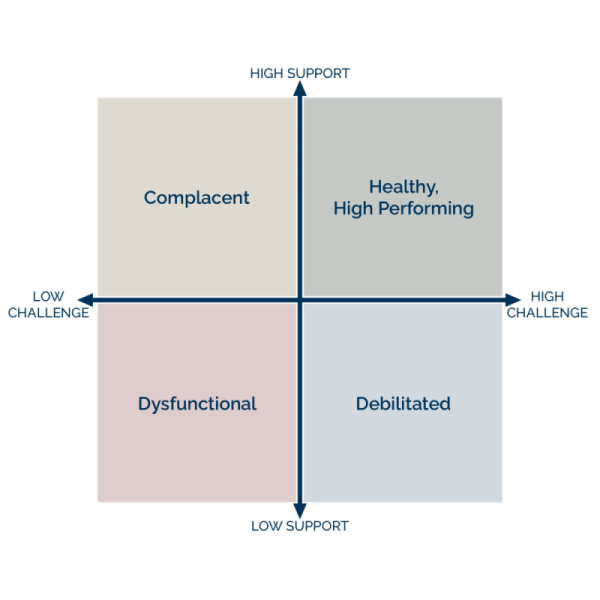
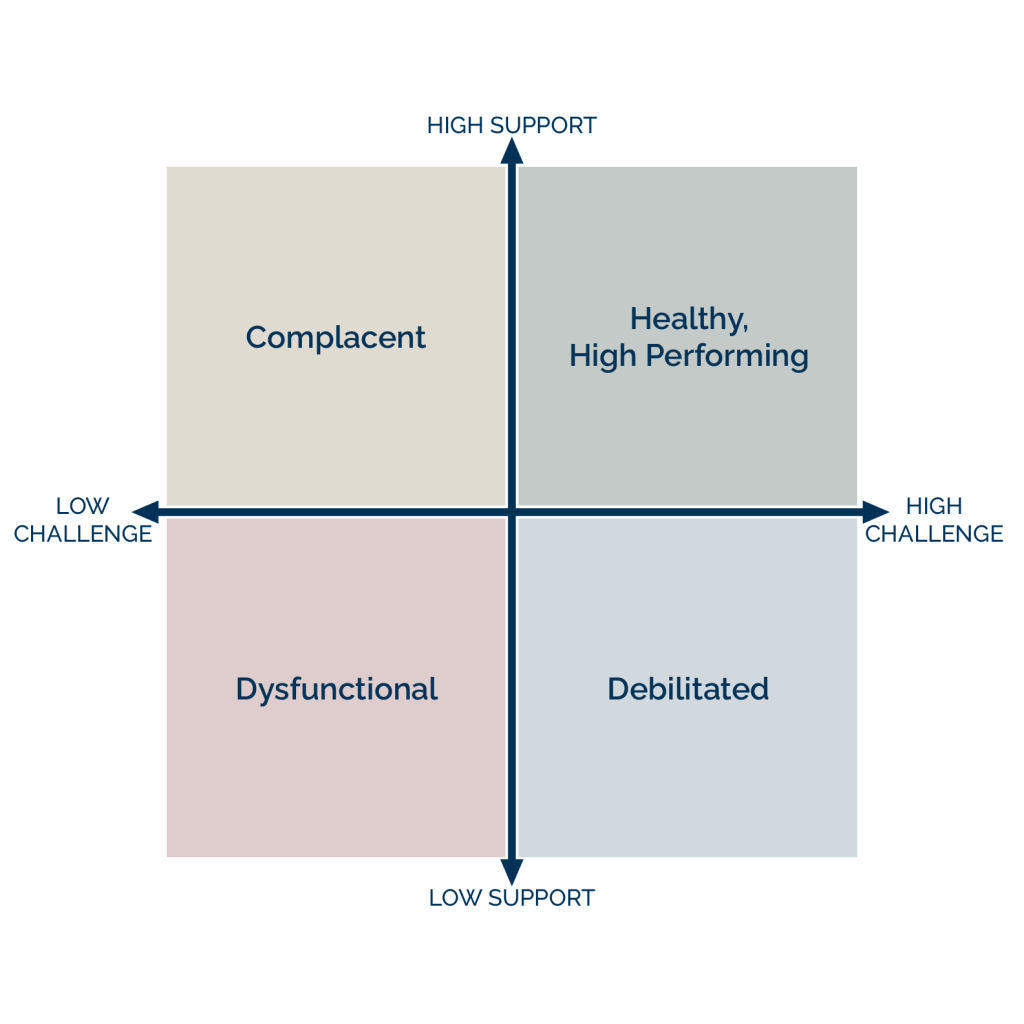
I don’t know where I first came across this chart, but now I refer to it all the time. I saw it in so many places that it started to seem like something that has always just existed in nature! But, credit where credit is due: the “Support-Challenge Matrix” was developed by Ian Day and John Blakey and presented in their book, “Challenging Coaching“.

They labelled the quadrants as:
- inertia/apathy (bottom left);
- comfort zone (top left);
- stress (bottom right); and
- high performance (top right).
See this article for more detail. I’ve adopted the labels and colour coding shown below:
Real World Examples
Coach Miller
An example from my own life that stands out was a moment with my high school basketball coach, Mr. Miller. One day he said to me that he noticed I was usually middle-of-the-pack when we did “suicide” sprint drills. He said I was actually one of the fastest runners on the team (high support), and I could be done every drill first or second (high challenge). After that, I was always first or second.
Mr. Miller didn’t tell me I wasn’t trying hard enough. He didn’t call me lazy, or say I wasn’t applying myself. That would have been low support, or maybe it’d be more accurate to call that anti-support. I got the sense that he believed in me (high support) and that he had every expectation that I could meet a high standard. And I did!
Chef Thomas Keller
Examples of this type of leadership can be seen all over the place if you just keep your eyes peeled. My colleague pointed out an incredible example from the restaurant industry: Chef Thomas Keller, the only American chef to have been awarded simultaneous three-star Michelin ratings for two different restaurants.
In The Bear Season 3 Finale Episode 10 (Hulu, Disney+), you can see an example of this when he speaks with a brand new chef on his first day. A small clip of his onboarding speech is available on YouTube. Check it out, and see if you can notice the tiny, subtle (yet huge and powerful) ways he expresses both challenge (high standard) and support.
NFL Coach Andy Reid
Despite the Kansas City Chiefs receiving many Ds and Fs on the NFL Player Team Report Cards 2024, as well as a C+ and a C-, the team has won several Superbowls, thanks to Andy Reid’s A+ coaching!
Players and assistant coaches alike agree that Coach Reid has high standards, an uncanny attention to detail, and balances this out with a great sense of humour and willingness to accept players for who they are. He even embraces the passion of players like Travis Kelce, even though that passion might get the better of them sometimes. In the Super Bowl LVIII, Kelce was frustrated and pushed his coach on the sideline.
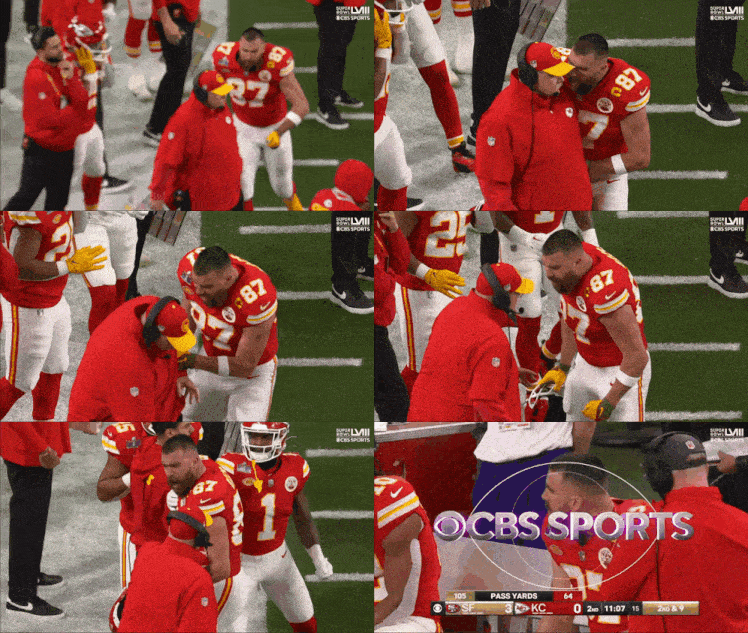
“Reid laughed off the incident following the Chiefs’ victory over the San Francisco 49ers, telling CBS’ postgame show, “He keeps me young. He tested that hip out. He caught me off balance – normally, I’d give him a little bit, but I didn’t have any feet under me.”
Kelce knew he was wrong: “I can’t get that fired up to the point where bumping Coach and it’s getting him off balance and stuff. When he stumbled, I was like: ‘Aw, sh*t’ in my head. If he would have cold cocked me in the face right there, I would have just ate it. I would have been like: ‘Let’s f**king go.’”
“Instead, Reid told him that he loves Kelce’s passion and that it fired him up even more to get a win for him.”
From another leader, this might be the sign of being a pushover. But from a coach who holds his players to super high standards and obviously gets the best from them, we can see that he strikes a great balance between challenge and support.
A few quotes from players:
- You just never wanted to disappoint him.
- Andy Reid is a guy you play for. You just don’t work for Andy Reid.
- Something about Andy Reid is just different, and that’s why he’s one of the greatest.
 Annalise