
Back to Resources | Jump to Contents
Great leaders foster psychological safety by creating an environment where team members feel valued, heard, and empowered to share their ideas without fear of judgment or punishment. They actively encourage open communication, show genuine appreciation for diverse perspectives, and respond to mistakes with curiosity rather than criticism.
By modeling vulnerability, admitting their own errors, and fostering a culture of trust and respect, leaders build teams where individuals feel safe to take risks, innovate, and collaborate effectively. This not only enhances morale and engagement but also drives higher performance and long-term success.
Contents
- NYT Article on Project Aristotle, Google’s Foundational Research that discovered the importance of Psychological Safety to team effectiveness
- The Fearless Organization: Creating Psychological Safety in the Workplace for Learning, Innovation, and Growth, by Amy C. Edmondson.
- The 4 Stages of Psychological Safety: Defining the Path to Inclusion and Innovation, by Timothy R. Clark
- Article: What is Psychological Safety? by Amy Gallo
- Psychological Safety Case Studies
NYT Article on Project Aristotle, Google’s Foundational Research that discovered the importance of Psychological Safety to team effectiveness
My intro to psych safety came from this article!
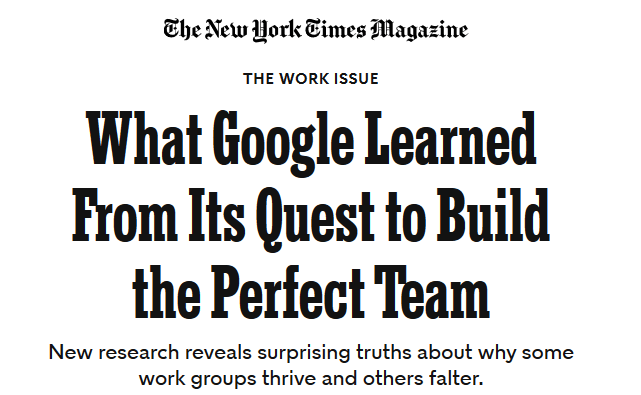
A massive team of researchers came together to figure out why some of Google’s teams of super awesome people were functioning extremely well while others weren’t. Spoiler alert: psychological safety!
Psych safety was the single biggest determinant of team performance. Those team who had it also tended to have leaders that leaned into vulnerability. Or call it humanity. Or call it the opposite of perfectionism!
Amy Edmondson (see her awesome book below) coined the phrase psychological safety and helped Google out a lot. I hope this article transforms your life and leadership (and thus other people’s lives and leadership) as much as it did for me!
The Fearless Organization: Creating Psychological Safety in the Workplace for Learning, Innovation, and Growth, by Amy C. Edmondson.
When Google launched Project Aristotle to find out what made some of their teams perform so much better than others, they thought it was probably going to be getting the right mix of demographic factors: age, education, extroversion, or maybe something to do with how much time team members spent together outside of work.
Instead, they were surprised to find out that the biggest predictor of team performance was the level of psychological safety within the group. Amy Edmondson was instrumental in this research and in helping Google understand the construct and how to maximize it (and productivity/profitability). In fact, Amy Edmondson coined the phrase psychological safety.
- Explore the link between psychological safety and high performance
- Create a culture where it’s “safe” to express ideas, ask questions, and admit mistakes
- Nurture the level of engagement and candor required in today’s knowledge economy
- Follow a step-by-step framework for establishing psychological safety in your team or organization
Bonus Materials (articles, podcasts)
- Amy Edmondson’s psych safety website with tons of articles, videos and other resources
- Amy Edmonson’s foundational article
- HBR podcast “What is psychological safety, really?”
- What Psychological Safety Is Not (article)
- Psychological Safety in High-Performance Police Teams (Article)
The 4 Stages of Psychological Safety: Defining the Path to Inclusion and Innovation, by Timothy R. Clark
Now that we know psychological safety is a thing, and a very important thing, we can drill down in a little more detail. It’s exciting to know that psych safety isn’t something you either have or you don’t. And, I like knowing that there are stages or levels to psych safety. It’s like the map in the mall that says “you are here” so you can figure out where to go from there.
- Inclusion safety: Safe to belong to the team
- Learner safety: Able to learn through asking questions
- Contributor Safety: Safe to contribute your own ideas
- Challenger Safety: Can question others’ ideas or suggest significant changes
The book’s website says, “This book is the first practical, hands-on guide that shows leaders how to build a culture of psychological safety. It’s your guide to creating an environment where employees feel included, fully engaged, encouraged to contribute their best efforts, and safe to speak-up and challenge the status quo.”
Video intro by the author
Article: What is Psychological Safety? by Amy Gallo
Excerpt:

Psychological safety is a critical concept for teams and the people that lead them. It’s also a topic we’ve covered quite a bit at HBR. But not everyone knows or fully understands it, so I reached out to Amy Edmondson, the Harvard Business School professor and author of The Fearless Organization, who coined the phrase “team psychological safety,” to get a refresher on this important idea. I asked her about where the term originated, how it’s evolved, and, of course, how people can think about building psychological safety on their own teams.
Psychological Safety Case Studies
Google X examples: Video 1 | Video 2
Philadelphia Eagles Coach Example (Article)
Scotiabank CEO Case Study (Article)
Ice Climber Example – how you respond in a situation (where people’s lives might be on the line) might affect whether they will speak up the next time there is a serious concern)
Leadership | EQ | Communication | Culture | Psychological Safety
Group Dynamics | Healthy, High-Performing Teams | RESOURCES HOME
 Annalise