
Recall the four aspects of Emotional Intelligence in Daniel Goleman’s model:
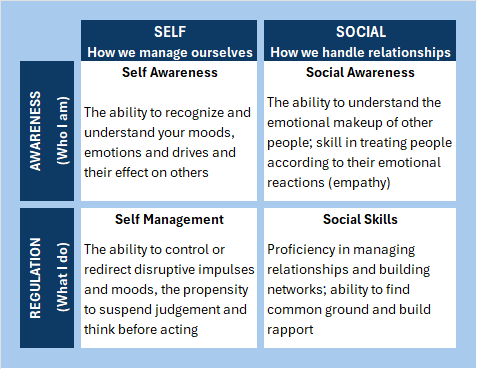
- Self-awareness: Understanding your own emotions and their impact
- Self-management: Managing your emotions
- Social awareness: Being aware of the emotions of others
- Social Skills: Managing relationships
Self Awareness
Leaders need to be aware of the emotions they are bringing into a conversation. They have to understand their moods, emotions and drives and their effect on others.
They need to realize the stories they have made up about a situation that are causing an emotional chemical reaction. For example:
“This person’s behaviour means they don’t respect me.”
“If someone does that, they must be lazy.”
Self Management
As a leader, I need to manage my own emotions. I cannot rely on other people to change their behaviour so that I feel better. I need to be able to soothe my own frustrations or outrage and quiet the voices in my head so that I can be curious about the emotions of others.
To successfully approach a potentially difficult conversation, I have to develop the propensity to suspend judgement and think before acting. This enables me to transform a difficult conversation to a learning conversation.
Social Awareness
In a difficult conversation, I need to listen for the emotions bouncing around inside the other person when a topic comes up. I also need skill in treating people according to their emotional reactions (a.k.a. empathy).
Social Skills
As a leader, I need the skills to build relationships, find common ground and build rapport. I must hold myself accountable for transforming difficult conversations into to learning conversations by creating the conditions for the other person to feel safe enough to discuss the emotional level.
I may need to lead in vulnerability and share what’s going on for me beneath the surface, in order to create the psychological safety for the other person to let down their guard as well. As a leader, I have to have the courage to take the first step.
 Annalise