
Back to Resources | Jump to Contents
People are so complicated! And when you group them together they get exponentially more complicated. Worse yet, most of what goes on with humans is subconscious or at least unspoken. But, we aren’t as complex as we might like to think, and we can be rather predictable even! These are some great resources to help organize some of the mystery.
Contents
- Unconscious at Work (Wilfred Bion’s foundational work on group dynamics), article by Jon Stokes
- Covert Processes at Work: Managing the Five Hidden Dimensions of Organizational Change, by Robert J. Marshak.
- The Wisdom of Crowds, by James Surowiecki.
- Stages of Group Development (Tuckman’s Model)
- Biosphere 2 Case Study | Life Sciences in Space Research
- The Rescue | National Geographic Documentary Films
Unconscious at Work (Wilfred Bion’s foundational work on group dynamics), article by Jon Stokes
A few excerpts:
“A major contributor to our understanding of unconscious processes in groups was the psychoanalyst Wilfred Bion, who made a detailed study of the processes in small groups in the army during World War II, and later at the Tavistock Clinic. On the basis of these, he developed a framework for analysing some of the more irrational features of unconscious group life. His later work on psychosis, thinking and mental development (Bion 1967, 1977) has also contributed much to our understanding of groups and organizational processes.”
“According to Bion, much of the irrational and apparently chaotic behaviour we see in groups can be viewed as springing from basic assumptions common to all their members. He distinguished three basic assumptions, each giving rise to a particular complex of feelings, thoughts and behaviour: basic assumption dependency, basic assumption fight-flight and basic assumption pairing.”
Google’s AI generated this easy-read version of the three assumptions for me:
- Dependency: Group members look to a leader for guidance, security, and solutions. Group members may place great faith in their leader.
- Fight/flight: The group focuses on a common enemy or threat. The group may feel threatened by an internal or external source. They may believe that a powerful leader is needed to lead them to victory.
- Pairing: The group has a shared hope. The group may focus on one or more dyadic pairs within the group. Group members may discuss romantic expectations and fantasies.
Bion believed that these assumptions are often unconscious and play a significant role in shaping group dynamics. He argued that by understanding a group’s basic assumptions, one can understand how the group’s emotional climate impacts its functional purpose.
Bion’s basic assumptions can simplify complex issues and enable a group to manage its anxiety and internal conflict.
Covert Processes at Work: Managing the Five Hidden Dimensions of Organizational Change, by Robert J. Marshak.
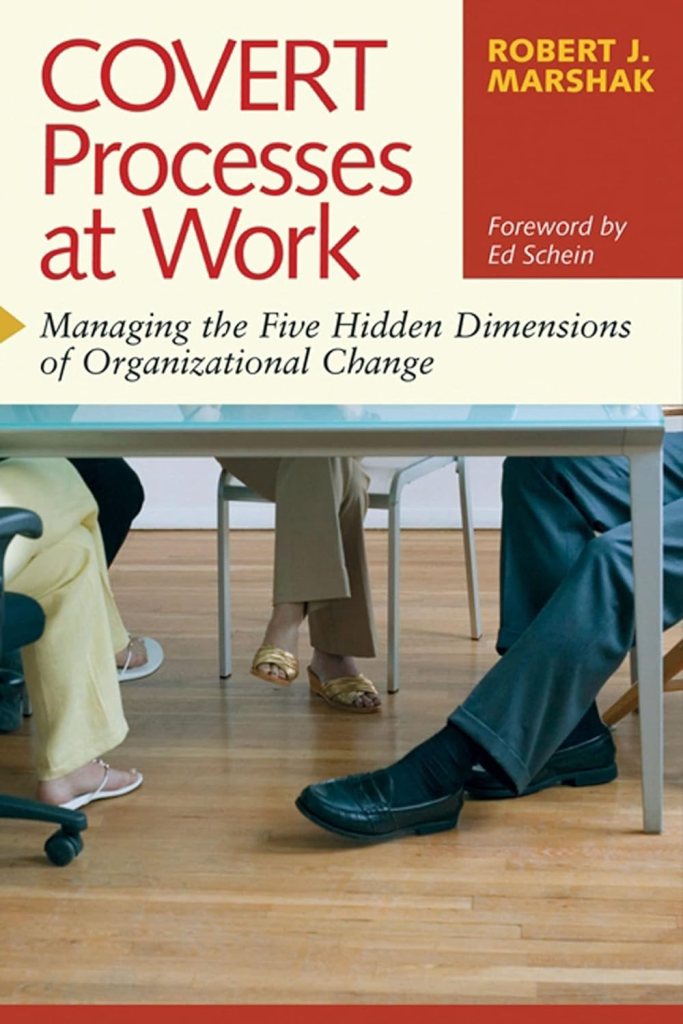
When I’m facilitating a session on emotional intelligence, I like to start out by establishing that our inner world is like an iceberg. Above the waterline is all our rational thought: stuff we are pretty aware of and don’t mind saying out loud. But most of what goes on inside a human being (or an organization made up of humans) is below the waterline. It’s under the table, not on the table.
We might like to think we are rational beings who sometimes feel emotions; in fact, we are emotional beings, wired for connection, who are sometimes capable of rational thought. Even economists largely abandoned the rational market theory decades ago!
This book takes the same idea and applies it to organizational change initiatives: “Organizational change initiatives often fail because they focus exclusively on the rational, overt aspects of change, overlooking the powerful role played by concealed or irrational factors. It’s well known that these covert processes—such as hidden agendas, blind spots, office politics, tacit assumptions, secret hopes, wishes and fears—frequently sabotage change efforts, but up until now nobody has offered a rigorous, consistent way of identifying and dealing with them.“
The Wisdom of Crowds, by James Surowiecki.
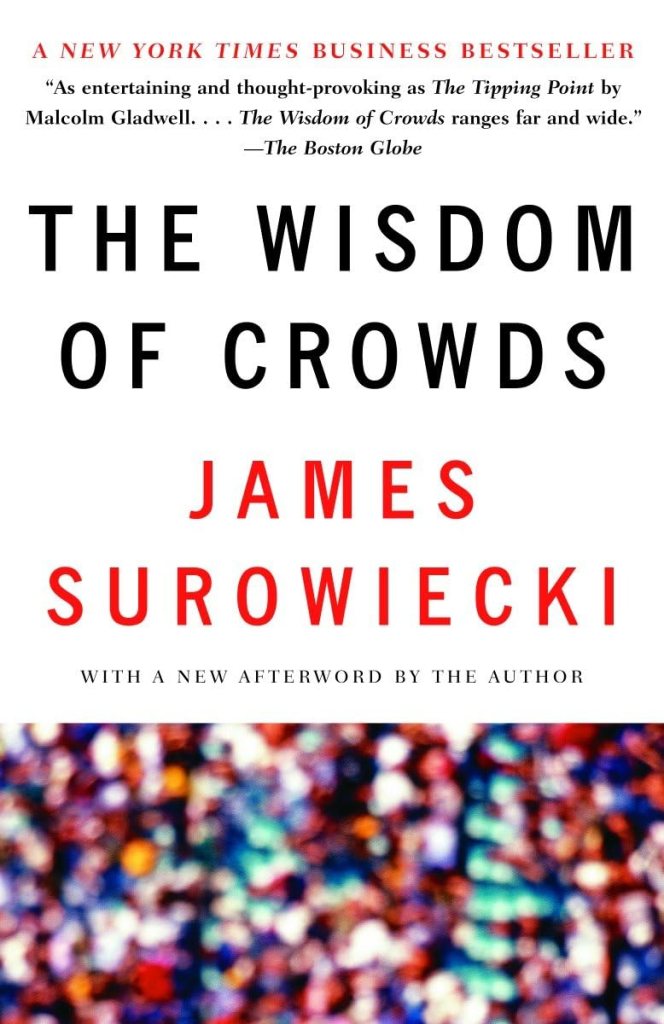
Writeup from the book’s page: “In this fascinating book, New Yorker business columnist James Surowiecki explores a deceptively simple idea: Large groups of people are smarter than an elite few, no matter how brilliant—better at solving problems, fostering innovation, coming to wise decisions, even predicting the future.
“With boundless erudition and in delightfully clear prose, Surowiecki ranges across fields as diverse as popular culture, psychology, ant biology, behavioral economics, artificial intelligence, military history, and politics to show how this simple idea offers important lessons for how we live our lives, select our leaders, run our companies, and think about our world.”
Article, The Right Way to Use the Wisdom of Crowds, by Julia A. Minson and Brad DeWees
Stages of Group Development (Tuckman’s Model)
The most commonly used framework for a team’s stages of development was developed in the mid-1960s by Bruce W. Tuckman.
Bruce Wayne Tuckman (November 24, 1938 – March 13, 2016) was an American psychological researcher who carried out research into the theory of group dynamics. In 1965, he published a theory generally known as “Tuckman’s stages of group development“.
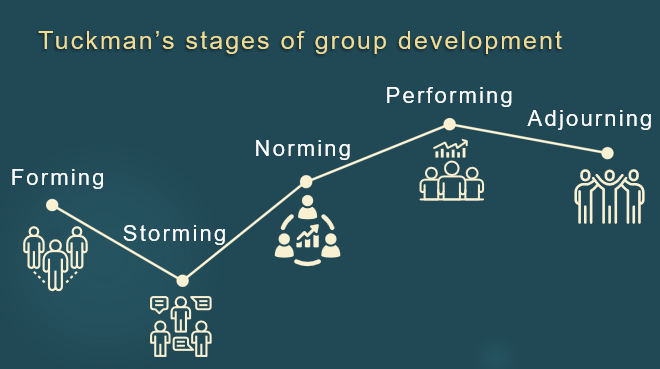
According to his theory, there are four phases of group development, they are: Forming, Storming, Norming, Performing. In 1977, he added a fifth stage, named Adjourning.
Tuckman was also known for his research on college students’ procrastination and development of the Tuckman Procrastination Scale (1991).
| Stage | What Happens | How Leaders Optimize |
| Forming | Excitement, anxiety Beware false productivity | Actually form! Get to know one another Be authentic early |
| Storming | Frustration, self-doubt Value conflicts; jockeying for roles Progress feels slow, obstacles appear everywhere | Don’t Skip Storming Let it healthily happen Lead the way through it Vulnerability is key Difficult conversations |
| Norming | Comfort, safety Settling in to how we’re going to do things Realignment of expectations | Constantly monitor; iterate as required Open communication Be deliberate about what norms are allowed to take hold |
| Performing | Positivity, cohesion Momentum, productivity | Use collaborative / bottom-up Norming Co-create norms relevant to the group Test and adjust |
| Adjourning | Decrease in productivity Sadness, accomplishment | Acknowledge what is happening Meaningful ceremony to mark the end of your time together |
Group Dynamics Case Studies
Biosphere 2 Case Study | Life Sciences in Space Research
From the abstract: “Successfully managing group dynamics of small, physically isolated groups is vital for long duration space exploration/habitation and for terrestrial CELSS (Controlled Environmental Life Support System) facilities with human participants. Biosphere 2 had important differences and shares some key commonalities with both Antarctic and space environments. There were a multitude of stress factors during the first two year closure experiment as well as mitigating factors.”
The Rescue | National Geographic Documentary Films
An extremely unlikely group of experts from across the globe comes together in what could have been a super weird group dynamic. The doc chronicles the enthralling, against-all-odds story that transfixed the world in 2018: the daring rescue of twelve boys and their coach from deep inside a flooded cave in Northern Thailand.
International Space Station Group Dynamics | Oleg O Ryumin and Yuri A Bubeev
International interplanetary expeditions will, by their very nature, require crew members from different nations to work and live together for extended periods, so an important element of planning a flight programme for such a mission is the consideration of different national psychological and cultural characteristics. Among other things, this involves ensuring a tolerant, ethnically-aware environment in the crew training process. This article considers the foundations of individual and group communication in understanding the ethnopsychological characteristics of crew members from different nations.”
Leadership | EQ | Communication | Culture | Psychological Safety
Group Dynamics | Healthy, High-Performing Teams | RESOURCES HOME
 Annalise